Is Art Truly Subjective? The Debate Goes On…

Is Art Truly Subjective? The Debate Goes On…

We all have our own culture, values, and opinions that undeniably end up defining and influencing our taste and preferences on different subjects. Art is without a doubt subjective… Right? At least it’s what we’re told. But, honestly, if art is so subjective why were some white canvas chosen to be displayed in the biggest museums in the world and others aren’t? Who decides and defines good art vs bad art? Are famous artists more skilled than the average one?

Perhaps if my favourite colour is black but yours is blue, it doesn’t make my preference any better than yours, because it’s only a personal preference. However, if I say that Basquiat is the best artist in the world but you say it is Warhol, there’s enough records and documentation that prove that Da Vinci might be classified as the greatest of all time.

Art always brings up a lot of conflicting opinions. Nothing is that black and white, and specifically when we talk about art. The value we give to art can definitely be subjective.

There are a lot of circumstances that go into our perceptions of whether art is good or not. So, without further a due, let’s dive into a few of them.

Subjectivity… To some extent
Art is subjective because we see things and interpret what we see differently than one another. Consequently, popular opinion can be highly manipulated by the amount of fame of one particular artist, the amount of mediatic exposure and recognition, and the social trends going on when following the latest events in the art world. It’s inevitable, opinions will change over time and so can our perception of art.

Even if we consider the appreciation of an artwork relative, if an artist wants to be featured in a museum, the process is quite objective:

Recognition; the artist must have participated in tons of exhibitions, nationally and internationally. Without exhibitions, there’s no recognition and without recognition, there’s virtually no interest in displaying works of artists that haven’t been exhibited anywhere.

– The artist’s works have to ignite the interest of collectors besides the general public. The artworks cultural, social and political context needs to be relevant and appropriate, otherwise, there’s no public nor private investment.

Lastly, the artists must have a certain level of media coverage surrounding them. Without it, there’s also no recognition and without recognition, – again, there’s no interest in their work…

Why Subjectivity is Good in Art

Ok, so for example, at Mariana Custodio we only focus on contemporary art and even inside contemporary art we focus more on abstract expressionism than on figurative expressionism, still that doesn’t mean that figurative art is bad or less worthy, that is only our personal preference. The fact that we all appreciate art in different ways is what gives artists the freedom to create whatever they feel called to create. 

How awful would it be if we decided that there’s only one type of art? We wouldn’t have so many amazing styles or nor creative movements. The fact that we can all unanimously decide what types of art we like allows room for many more art styles to coexist, giving us the opportunity to learn about what we like and what we identify the most with.

Liking Something vs It Being Good
Just because I enjoy looking at a painting doesn’t mean that I think that its aesthetic and technical quality is good. I can enjoy a lot of books but, – again it does not mean that I like them all or that I think the quality of each one of them is great. The same applies to music, movies, fashion and of course art.

When a work of art isn’t judged by experts, where are can we assess objective criteria that tell us whether art is good or bad? I don’t know if you’ve experienced the same but I’ve never gone into a gallery to find a selection with all of the criteria and the necessary requirements for an artwork to be considered good. Some will say that the fact that it’s in a gallery to begin with, is the ultimate evidence that it’s good… However, we’ve all seen some questionable works in galleries… In this way, subjective responses bleed into the “objective” state of things. So we can’t exactly rely on institutions to be in charge of evaluating and deciding what is art and whether it’s good.

So, when we don’t have objective standards to use when we form our opinions of art, how do we decide what is good art?

How Do We Decide What is Good Art
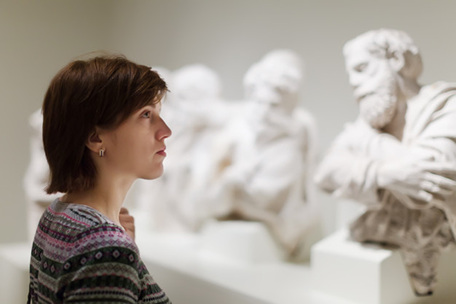
We are constantly shown different opinions, perspectives, criticisms, and more. We are constantly challenged to defend our points of view and to stand up for causes we believe in. We are continually discovering new artists and deciding what we value in the art world.

It’s particularly difficult to unanimously and universally come to a decision about art when everyone has a different opinion about it… If everything we like, hate or feel indifferent about has been shaped by our life experiences, it’s nearly impossible to weed out everything that could have influenced the reasons why we like a piece of art and simply look at it objectively. So, should we worry that subjective opinion is influenced by the world we live in? Wouldn’t this mean that we’re forming opinions with a very particular perspective on our own experiences? The answer is yes…!

We put a lot of value in trying out new things, seeing the world, and meeting new people. And those are the first steps that will get us closer to deciding whether an artwork is good or bad. This is a very democratic process, opinions on subjective matters are formed when we take a look around, when we compare, analyse and experience different scenarios. What you experienced in the past and what you choose to expose yourself to now plays a great role in the way we, as a community, seek out art and form opinions about it. If we don’t see enough, we might not have enough information to make valid and informed opinions…

Popularity Influences our Opinion About Art

Artists with more visibility are usually the ones that make the most impact. Therefore, when something becomes popular, it usually increases in likability. A lot of that comes from the amount of exposure they already have. When something becomes popular, it gets people talking. Given technology these days, this can really favour artists that understand how to use social media…

Right, so naturally, a specific artwork is more attractive when people know it exists. You can’t like something or decide the aesthetic value of a piece when you don’t know exists. Once visibility spreads and something becomes popular and mainstream, people will simply gravitate towards it. Without questions to ask, it’s easier to accept what comes to us, we tend to agree more on what is easier to hear or is more convenient at the time. It’s very common to believe we like a piece of art more than we do just so that we can have a deeper communal connection to a group.

How Artists Themselves Influence Subjectivity

We often feel a lot of loyalty towards the artists we know and admire. Oftentimes we tend to support them and their work despite actually considering if what they produce is good or bad. We tend to become biased in relation to what we know we already like. We have empathy towards people we admire so we regularly favour them and put them on a pedestal even if we don’t like what they’re making.

So this is definitely another aspect to have in consideration when evaluating art. If an artist already has a following and an established fan base, it’s more likely that the artist’s work is considered good and valid, despite any technicalities their work might have against it.

When thinking about the style art that you like, look to your absolute preferred artist as a hub. What other artists alike come out from that hub? A lot of times you’ll see that your favourite artists sent you down a pathway of discovery with other artists in that style. It’s not a bad thing, but just a way to see how your subjective perspectives can get biased more easily.

The Dilemma

To foreground subjectivity as the most appropriate response to a work of art threatens to overlook the fact that tastes and preferences do in fact change over time, just as morals and public standards change too. Yet, subjective taste has a historical dimension, even if we prefer to think it doesn’t…

In art, we tend to place lot of emphasis on originality and creativity, right? But with the neverending shift in traditions and cultures, there are many examples of artistic “revolutions” that have failed to meet with the tastes of society at the time, only to be subsumed into the conventional appetites of later generations. For example, the Impressionist paintings of Monet and Cezanne. One critic back then complained that both of their paintings were half-finished sketches.

The ways that people look at the world around them — at works of art or anything else — are prone to influence from so many other spheres, from political upheavals to technological advances. What counts as “knowledge”, “proper behaviour”, “judgement” and “good taste” never stay the same.

Will art ever become an objective subject? Porbably not. In retrospect, no; it’s almost impossible to value an artwork as good and valid forever.

Conclusion

  • We cannot help but unconsciously build a criterion for what counts as valuable: for what type of work we think should be shown in galleries, what the art market should treat as valuable, who should win art competitions, and all the other practical ways that some artists’ work rises to the top whilst other artists’ work disappears without a trace.
  • At the end of the day, our subjective opinions are built by personal experiences and cultural background.
  • The unique thing about Art is about developing our own subjective opinions on why we love specific artists. Without subjectivity, art would lose a lot of what makes it so great in the first place.
  • If an artist already has a following and an established fan base, it’s more likely that the artist’s work is considered good and valid, despite any technicalities their work might have against it.
  • Artists with more visibility are usually the ones that make the most impact. Therefore, when something becomes popular, it usually increases in likability.

What Is Installation Art and What Isn’t

What Is Installation Art and What Isn’t

Like many movements, styles, and influences that make up modern and contemporary art, installation art is mostly rooted in conceptualism and transformation. Although comparable to sculpture and related to a variety of other artistic genres, this immersive practice offers a unique way to experience art. To grasp the meaning of such a movement, it is important to understand what makes it so particular, from its distinctive qualities to its technical characteristics.

So today, we’ll be going over this avant-garde movement, paying particular attention to its particularities, how it engages audiences and produces such impactful experiences.

What is Installation Art

In the contemporary world, where so many different art forms have been born, developed, explored and even forgotten over time, almost no other manifestation of art has been so instantly mesmerizing as installation art.

Influences and Origins

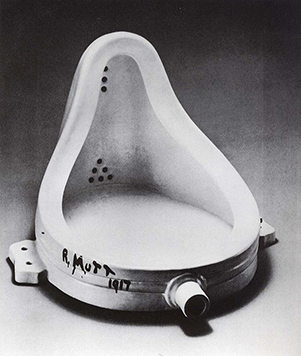
The origins of installation art are usually related to Conceptual art. Following the steps of artists like Marcel Duchamp and his innovative approach of presenting his readymades. Other noticeable influences that are considered to have paved the way for the development of installation art as we know it today include the Dada movement (Dadaism), particularly several works and assemblage art which notably filled entire rooms, theories of Spatialism, and even some pieces by John Cage.

Before being called installation art, this art movement was originally referred to as the environment. After Allan Kaprow, an American artist who introduced the concept of “happenings”, – a form of spontaneous, non-linear action, that revolutionized the practice of Performance Art. However, it wasn’t until the ’70s that the term Installation Art began to be applied in defining works that take into account the viewer’s entire sensory experience or that fill out an entire space.

Main Qualities

Installation artworks, – either permanent or temporary, are usually created to be exhibited in venues like museums and galleries, or public or private spaces. Installation art by itself can be such an ambiguous concept that it cannot be narrowed down to specificity. Due to the latest technological developments and enhancements, this art form allows the merging between video, sound, immersive virtual reality environments, the internet and performance with traditional media and other conventional resources used in fine arts practices. From natural to man-made materials, installation art allows full creative freedom over any artist’s work.

Furthermore, site-specific installations are produced to exist and “function” at the location for which they were commissioned, making these sensory projects often part of the surroundings. Other artworks can be relocated and displayed in different places, not depending on their environment. This sensory engaging art practice completely blurs the line between art and life.

Characteristics of Installation Art

Immersiveness

If not the most significant, it’s certainly an important aspect to have in consideration: installation art’s ability to physically interact with an audience. While some artistic mediums and outlets are capable of creating some sort of engagement and interactivity, installation art creates entirely immersive experiences that encourage dialogues between individuals and works of art. This single characteristic invites audiences to interact with artworks from multiple viewpoints.

Large-Scale

Given its interactive nature, most installation artworks are big in scale. Their sizable structures facilitate observers to become completely immersed in each larger-than-life environment. In several cases, it even allows them to sit, stand, rest or walk through it, — a distinctive ability not usually seen in other “classic” art forms.

Site Specific

Unlike sculptures, paintings, and other traditional art pieces, installations are usually designed with specific places and purposes in mind. From gallery rooms to outdoor spaces, the strategic nature of installation art designs and the uniqueness of their surroundings, site-specific works of art ensure a one-of-a-kind aesthetic and experience.

The difference between Sculpture and Installation Art

There’s a common misunderstanding and a general questioning about the difference between Sculpture and Installation Art. As much as some installation artworks may resemble traditional, hand-made sculptures, it doesn’t mean both these art forms can be put under the same category.

So, a sculpture is essentially something that you make out of specific materials, such as wood, metal or stone. You “sculpt” the material by changing its shape, by carving, assembling or casting and modelling. An installation is basically a display. It may or may not include sculpture; it’s usually created from different media. You can create an installation without “making” anything, just by arranging different objects.

Sculptures can be freestanding and self-supported, allowing the viewer to walk completely around the work to see it from every perspectivewhere the primary form’s surface is raised above the surrounding material, like the image carved on a coin.

Also, Installation Art can effectively deconstruct some traditional principles and concepts of sculpture. This happens whenever an artwork is created to be seen from the outside, from the inside or to be experienced as a self-contained composition of different elements.

On the other hand, installation pieces usually embrace and enclose an audience in the surroundings of the artwork. Besides, installation art is created with the intention of focusing on the viewer. Individuals almost become the main subject of the artwork, taking into consideration the spectator’s engagement and interaction with the art piece.

The formalism of the work essentially slips into the background, bringing the impact of the viewer’s spatial and cultural expectation to a focal point. The multi-sensory designed installation, creates an ongoing conversation with its surroundings, waiting for the spectator to take in both the creation and its environment as an overall immersive display.

5 Different Types of Installation Art

From pill packets and crumpled trash bags to mirrored rooms and giant mushrooms, installation art has given some of the boldest and boundary-pushing masterpieces of all time. Installation art has grown to be one of the most widespread forms of contemporary art practice, with artists adopting ever more adventurous and playful ways of transforming the way we experience art.

Allan Kaprow, Yard, 1961

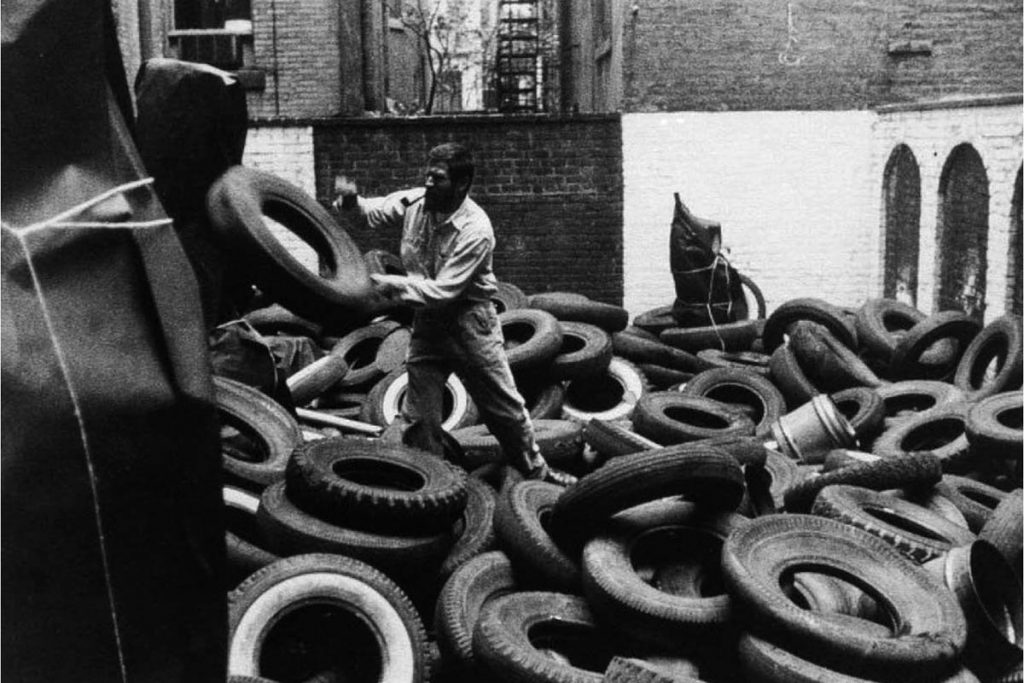
American artist Allan Kaprow’s Yard, filled the outdoor yard of Martha Jackson’s Gallery with black rubber tires and tarpaper-wrapped forms before encouraging participants to climb, jump and play in this monstrous playground. This iconic installation art opened up new sensorial experiences for visitors and allowed them to engage with art like never before. As well as exploring abstract ideas around solids and voids in space, Kaprow was a pioneer in bringing improvisation and group participation into art, “Life is much more interesting than art. The line between art and life should be kept as fluid, and perhaps indistinct, as possible.”

Damien Hirst, Pharmacy, 1992

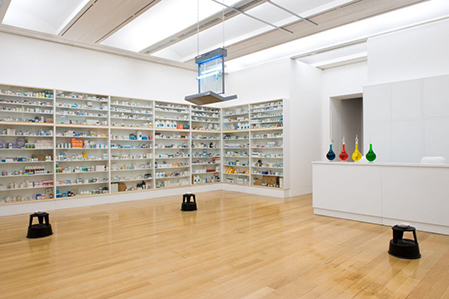
Created to mirror the cold, hospital-like atmosphere of an old-fashioned pharmacy, Hirst’s Pharmacy, includes a large collection of tablet packagings, medicine bottles and other medical objects in a harsh fluorescent white made-up environment. This iconic installation highlights the modern-day obsession with medication as a way to extend life expectancy without us having to question it. Hirst explained, “We all die, so this kind of big happy, smiling, minimal, colourful, confident facade that medicine and drug companies put up is not flawless – your body lets you down, but people want to believe in some kind of immortality.”

Olafur Eliasson, The Weather Project, 2003

Olafur Eliasson created The Weather Project, in 2003 for Tate Modern. He intended to replicate the effect of an enormous sun rising through a fine mist. Low-frequency lamps around his artificial sun allowed only the golden glow of the sun to dominate the space, reducing all surrounding colours to the magical shades of gold and black. Master of illusion and installation art, Eliasson designed the glowing orb from a semi-circle of light which is reflected by mirrored panels on the ceiling. These mirrored panels stretched over the whole ceiling, enabling visitors to see themselves reflected as if floating in the sky above them, creating the sensation of hovering weightlessly in space.

Yayoi Kusama, Infinity Mirrored Room – The Souls of Millions of Light Years Away, 2013

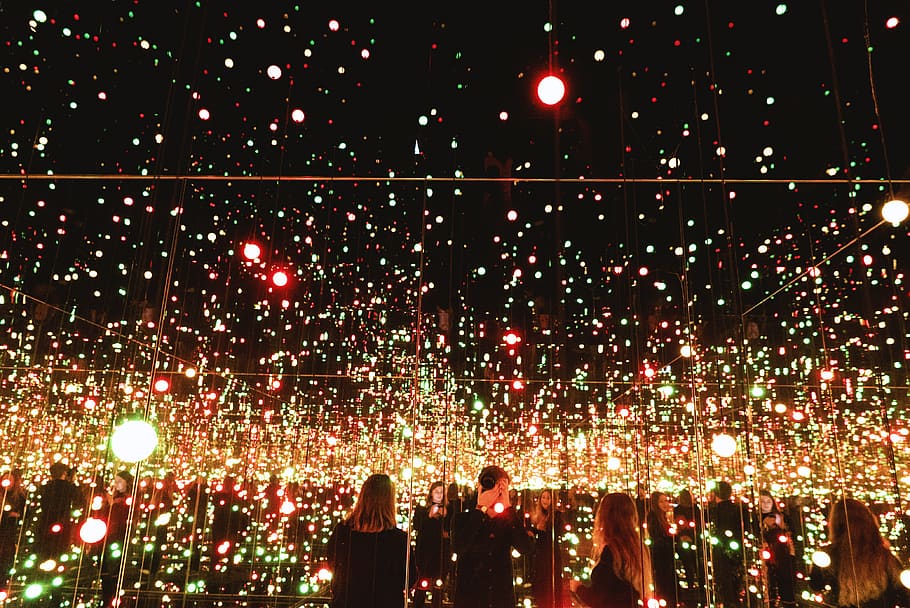
The Infinity Mirrored Room – The Souls of Millions of Light Years Away, is one of various immersive ‘Infinity Rooms’ which have peaked the interest of thousands of gallery-goers around the globe. Designed by placing mirrored panels throughout the walls, ceiling, and floors of a small, confined space, Kusama later fills it with tiny fibres of coloured lights and reflective objects around the room to create the effect of endless, infinite space. Just like entering a star-filled universe or merging into a digital superhighway, there’s truly nothing like the experience of going to an Infinity Room. 

Random International, Rain Room, 2013

Random International’s well-known installation artwork Rain Room, very much concisely unites art and technology into one. Visitants pass through a gushing torrent of rainwater but almost miraculously remain dry, as sensors detect their movement and cause the rain to stop around them. This deceptively simple idea from the London-based art collective embraces a natural symbiosis between art and the spectator as the installation only comes alive through physical interaction. 

Conclusion

  • Like many movements, styles, and influences that make up modern and contemporary art, installation art is mostly rooted in conceptualism, dadaism, spatialism and performance art.
  • Installation artworks, – either permanent or temporary, are usually created to be exhibited in venues like museums and galleries, or public or private spaces.
  • Installation art creates entirely immersive experiences that encourage dialogues between individuals and works of art.
  • Given its interactive nature, most installation artworks are big in scale.
  • Installations are usually designed with specific places and purposes in mind.
  • A sculpture is essentially something that you make out of specific materials, such as wood, metal or stone. An installation is basically an arranged display that can include a variety of different mediums and art practices.
  • Installation art has grown to be one of the most widespread forms of contemporary art practice, with artists adopting ever more adventurous and playful ways of transforming the way we experience art.

Why Is Art So Important: The Role of Art in Contemporary Society

Why Is Art So Important: The Role of Art in Contemporary Society

It seems remarkably apparent and ridiculously conspicuous the effect art has in society. I mean, yes, it’s pretty obvious – communities need art to grow and to thrive economically, culturally and socially. Art influences our opinions, it helps us installing values and transforms experiences across space and time.

But art can’t repay the public subsidy… Right? Art represents an investment on which there is virtually no return. So, the real question is why does art matter and why is it so important to us?

Why Does Art Matter?

If art is a cultural and social investment that cannot guarantee audiences and if it cannot show an immediate relevance – why does it matter?

Well, the Arts matter because they are relevant to the needs and wishes of society. Art helps individuals and communities to express their wants and needs, and it helps them to express these wishes in memorable and significant ways. Art allows and motivates us to communicate ideas in ways that politics or science simply can’t…

The arts reconstruct values and principles, and it has the power to rehabilitate marginalized structures. Art is essential to create symbols that people identify with and is necessary to give identity to places that may not have one.

How Art Affects Society

Right so, where the arts start, jobs follow. The arts stimulate the growth of the creative sector in the economy. They play an important part in the strengthening and shaping of the ideas of the marketplace. The creation, management and distribution of art employ many.
Not only it’s economically viable, but arts also help in fulfilling self-expression. Research studies from Newcastle University, back in 2013, revealed that attending art exhibitions and viewing contemporary art stimulates multiple cognitive perceptions of the elderly.
There is also a demonstrable, positive correlation between schoolchildren’s grades in math and literacy and their involvement with art-related activities.

How Art Affects Individuals

Painting, sculpture, literature and other arts are often considered to be the repository of a society’s collective memory. Art preserves what fact-based historical reports cannot: how it felt to exist in a particular place at a particular time.
Art, in this sense, serves as communication. It allows people from different cultures and different times to engage with each other via images, sounds and stories. Art is often a vehicle for social change. It can give voice to those who feel politically or socially marginalized. A painting, a photograph or even a simple drawing can stir emotions in those who encounter it, inspiring them to rally for change.

How Does Art Contribute to Economic Development?

In the US, the creative sector employs more people than the fast-food industry. The arts are growing faster than the overall economy, posting an average annual growth rate of 2.6%. A slightly higher value than the US’ overall economic growth of 2.4%, in 2015.
Using the United States as a reference again – by 2016, the US reported having exported nearly $20 billion more in cultural goods and services than any other country or continent did. Although most of these products are essentially visual media, independent artists and organizations contributed about $3 billion in just exporting.
Museums and Galleries alone added $6 billion.

But it’s not just the bigger cities and less developed areas that are benefiting from the creative sector. Almost half a million workers in rural areas in the US are working and practising creative and cultural-driven jobs.

The Value of Art

Despite its monetary value, arts shouldn’t be solely defined as if they were just another economic advantage to be uprooted. That way, the arts would be put in a level of activity where measurement of effects, predictability of results and direction of activity are rated as conditions of success. Consequently making cultural and artistic goods as grounds for profitable investment. Which… Puts us back in the bind of instrumentality.
So, is it possible to redefine the importance of art as a whole while simultaneously consolidating the fundamental importance of its economic benefits?

The short answer is yes. The long answer is: The value of Art cannot be predicted or quantified. To reduce Art into this condition is to deny the possibility of a changeable outcome. The prospects of funding Art allows far greater benefits than the direct and immediate fulfilment of the self – which isn’t profitable financially speaking.

But Arts connect society to its past and people to its inherited ideas. The Arts challenge those connections to find ways of exploring new journeys. The arts are evolutionary and revolutionary; they listen, they revive and they guide.
They resist the homogeneous, strengthen the individual and are independent in the face of the pressures of the mass, the bland, the undifferentiated.
For how big or small investments in this sector can be, the return is so far beyond palpable. Arts true value lies in transforming research into ideas. Real art might fail every measurable objective set by economists and politicians. But art is always art, no matter its variable outcome.

Conclusion

  • Art motivates us to communicate ideas in ways that politics or science simply cannot. It has the power to rehabilitate marginalized structures and improve systems creatively and socially.
  • The Arts affect us individually and as communities. It betters people’s lives by helping to instigate meaningful perspectives, it stimulates us cognitively and helps shape ideas in the marketplace.
  • The arts stimulate the growth of the creative sector in the economy. The creative sector is employing more people than ever, and less developed areas are benefiting from cultural driven activities.
  • Despite its monetary value, arts shouldn’t be solely defined as if they were just another economic advantage to be uprooted. Real art might fail every measurable objective set by economists and politicians. But art is always art, no matter its variable purpose.

Add to cart